01
13 / 06 / 2017
Entry into REIS
The Feast of Saint Agatha is included in REIS - the Register of Intangible Heritage of Sicily.

For more information send us a request:info@santagataunesco.it


Subscribe to the Newsletter
INFO & CONTACTS:
Subscribe to the newsletter to follow the UNESCO journey, get updates on the nomination, and discover initiatives, testimonials, and content dedicated to the Feast of Saint Agatha.



Menu
Menu
Information and Contacts
For information on the UNESCO application, initiatives, community contributions, and the journey of the Feast of Sant’Agata, contact us: we are at your disposal.
The Feast of Saint Agatha in Catania tells of a living heritage of faith, memory and participation. This site supports the UNESCO nomination process by gathering information, updates, documents and community testimonies, inviting everyone to actively contribute to the knowledge, safeguarding and transmission of the Feast.
About the Nomination Proposal
info@lafestadisantagatacatania.it
info@lafestadisantagatacatania.it
Website created by Flazio.com © 2026 All rights reserved
The photographic material was provided by: Antonio Parrinello, Fabrizio Villa, and Massimo Vittorio.
Website created by

From the proposal to the Application
It is not only about presenting to the world one of the most intense religious and popular festivals of the Mediterranean. The nomination aims to tell, safeguard and pass on a living heritage that belongs to Catania’s deep history and that, every year, continues to renew itself through the participation of its community.
The Feast of Saint Agatha is ritual, memory, devotion, collective organization, handed-down knowledge, lived urban space. It is the way Catania recognizes itself, moves through its own history and hands to new generations a bond that unites faith, culture, civic identity and shared responsibility. The nomination process is promoted by the Municipality of Catania, the Archdiocese of Catania, the University of Catania and the Committee for the Feast of Saint Agatha in the city of Catania, as provided for by the Memorandum of Understanding signed on 6 June 2025. The Memorandum identifies the Municipality of Catania as the lead body and establishes a Promoting Committee tasked with coordinating the activities needed for the nomination, supported by a Scientific Committee and by research groups and a technical staff.
The nomination of “The Feast of Saint Agatha in Catania” for UNESCO’s Representative List of the Intangible Cultural Heritage of Humanity stems from a shared path among institutions, the religious community, the scientific world and civil society
It is not only about presenting to the world one of the most intense religious and popular festivals of the Mediterranean. The nomination aims to tell, safeguard and pass on a living heritage that belongs to Catania’s deep history and that, every year, continues to renew itself through the participation of its community.
The Feast of Saint Agatha is ritual, memory, devotion, collective organization, handed-down knowledge, lived urban space. It is the way Catania recognizes itself, moves through its own history and hands to new generations a bond that unites faith, culture, civic identity and shared responsibility. The nomination process is promoted by the Municipality of Catania, the Archdiocese of Catania, the University of Catania and the Committee for the Feast of Saint Agatha in the city of Catania, as provided for by the Memorandum of Understanding signed on 6 June 2025. The Memorandum identifies the Municipality of Catania as the lead body and establishes a Promoting Committee tasked with coordinating the activities needed for the nomination, supported by a Scientific Committee and by research groups and a technical staff.
The Feast of Saint Agatha is included in REIS - the Register of Intangible Heritage of Sicily.
Why apply
The Feast of Saint Agatha is a living cultural heritage because it does not belong only to the past.
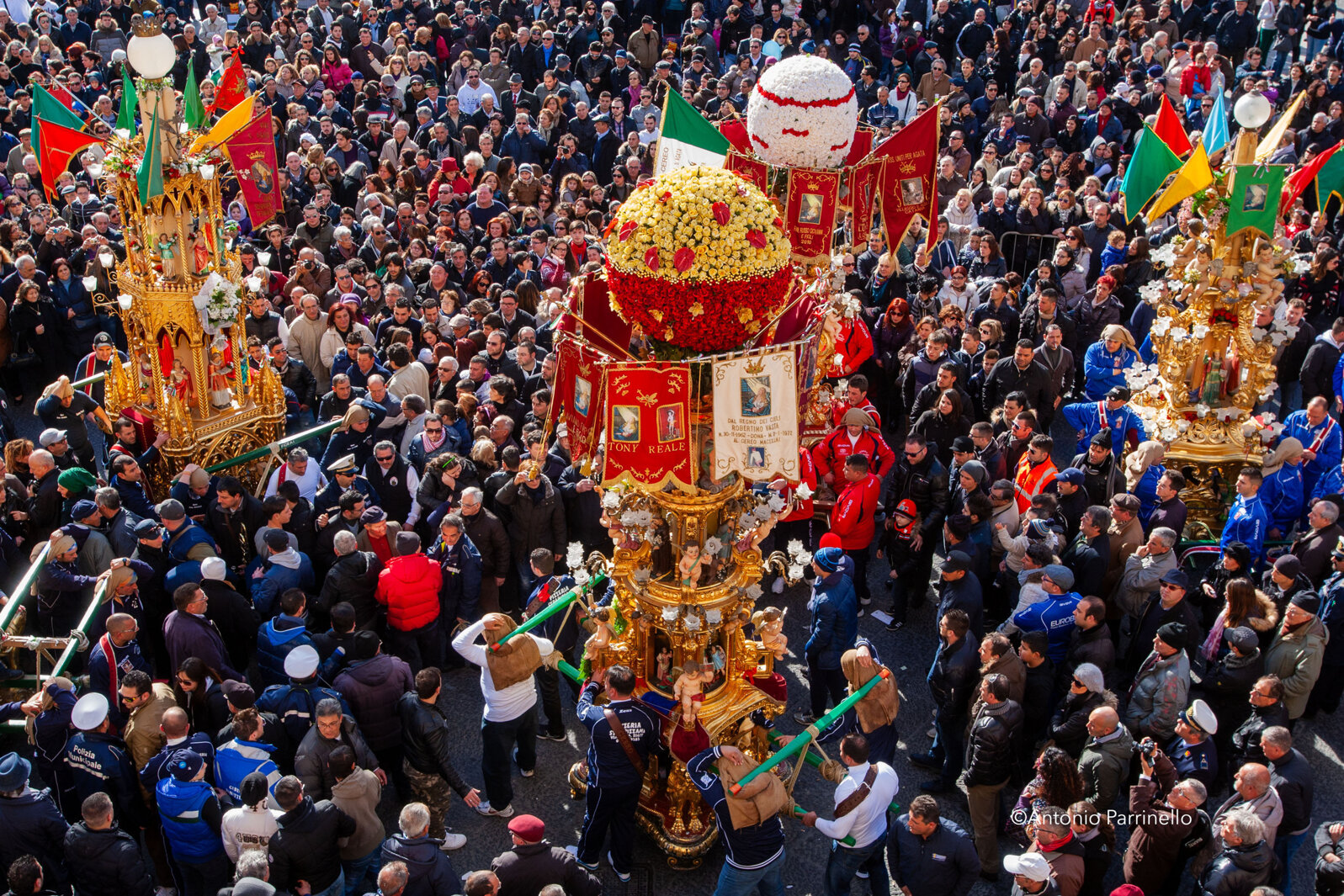
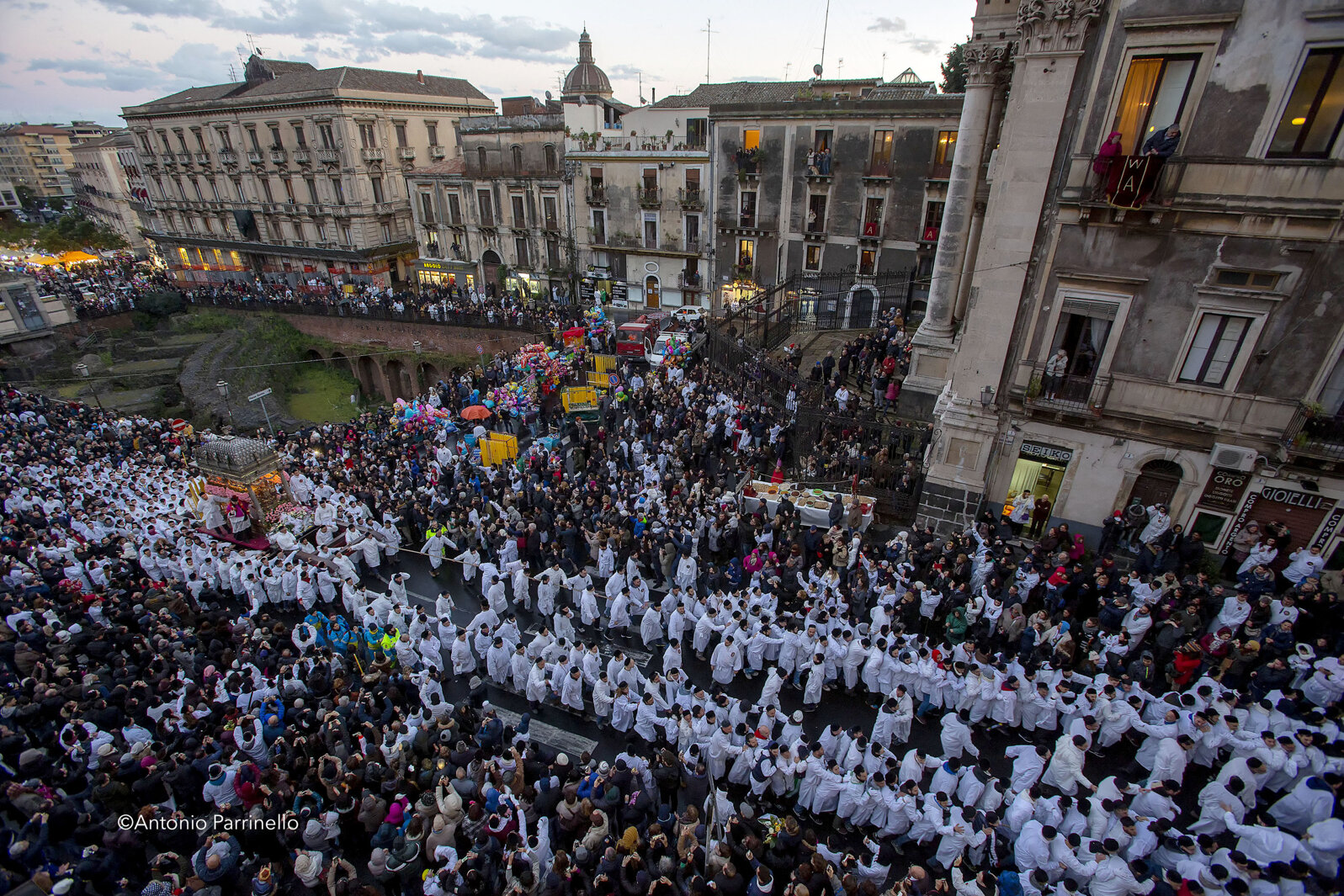
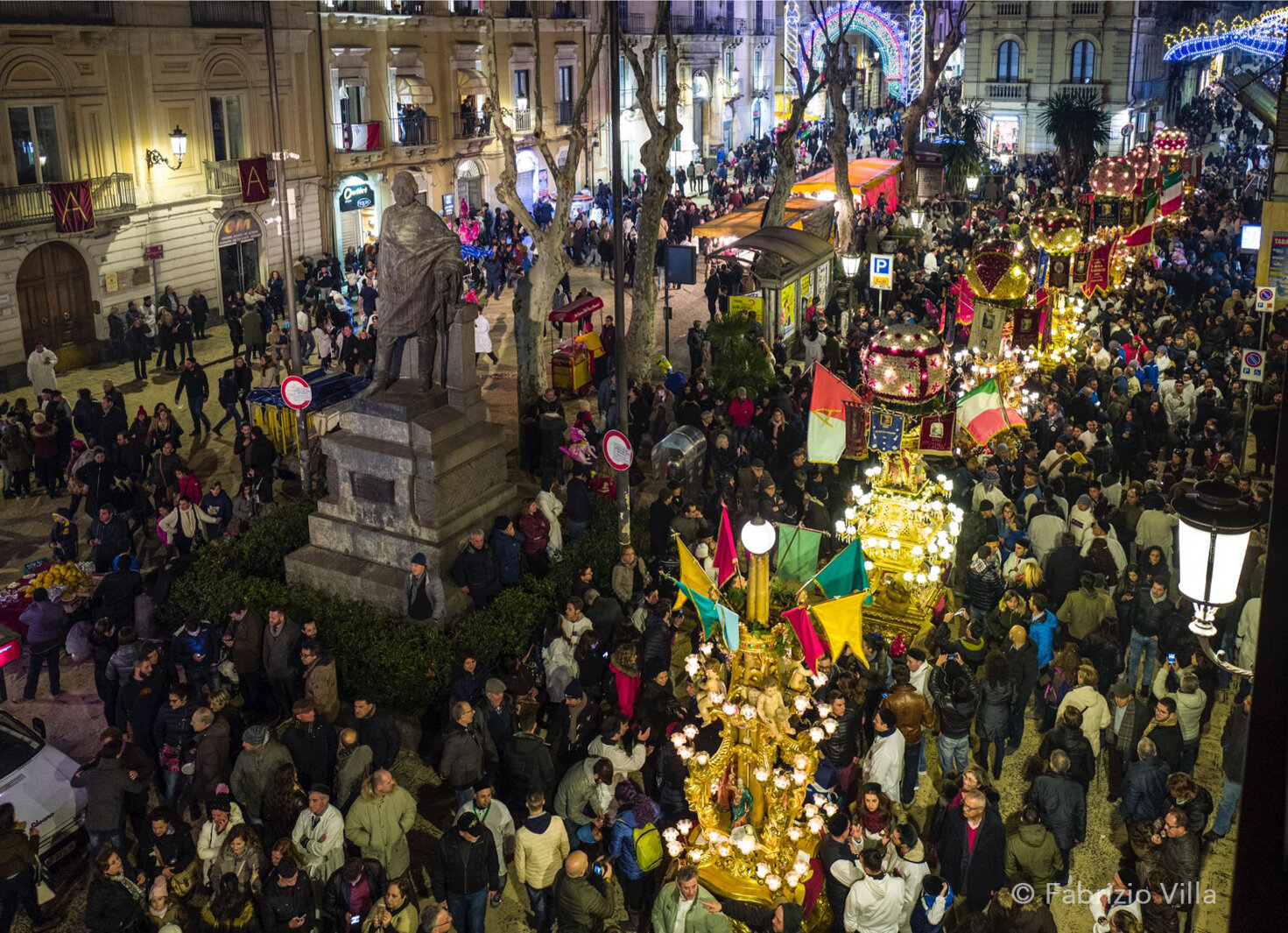
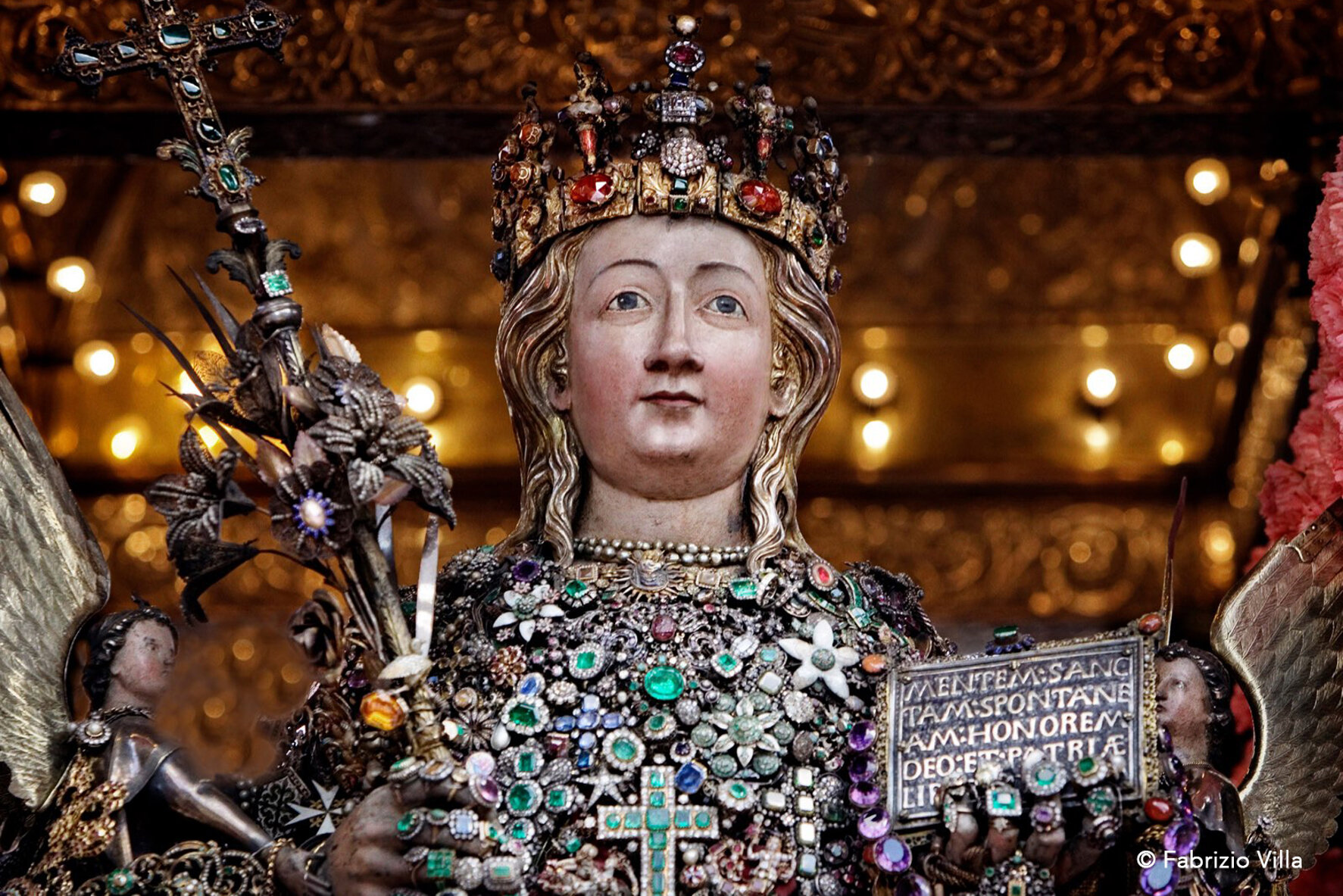
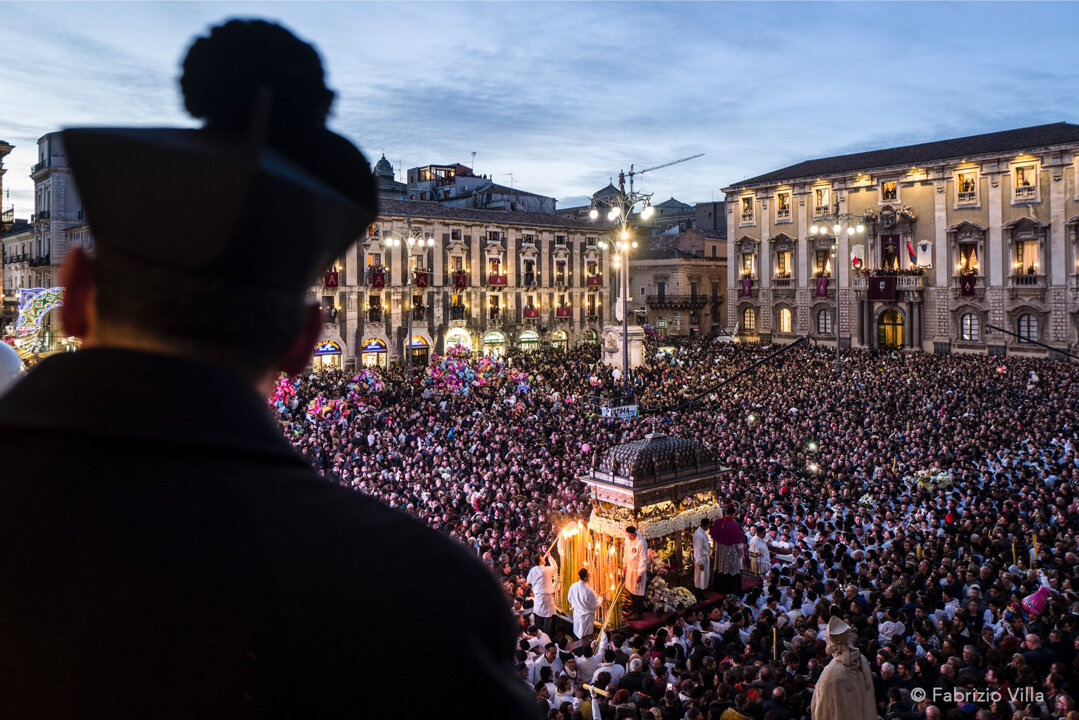
It lives in the present, in the voice of the faithful, in the step of the Candelore, in the fercolo that crosses the city, in liturgical celebrations, in organizational know-how, in the music, in inherited gestures, in the care of ritual settings, in the memory of families, parishes, associations, volunteers and all those who, in different ways, take part in its continuity.
Its strength lies not only in the greatness of the event, but in the depth of the bond that ties the Catanese community to its Patron Saint. Each year the city does not merely attend the Feast: it prepares it, awaits it, accompanies it, recognizes it as an essential part of its identity.
The history of the Feast intertwines with some of the decisive pages of Catania’s history. The memory of the return of the relics from Constantinople, celebrated on 17 August, points to a tradition that spans the centuries.
Even the great fractures of urban history - the eruption of Etna in 1669 and the earthquake of 1693 - did not erase the relationship between Catania and Saint Agatha. On the contrary, after those breaks, the Feast accompanied the city’s material and symbolic rebuilding, helping to redraw routes, spaces, squares and ways of living the urban center. After the earthquake of 1693, in fact, the layout of the rebuilt city led to a redefinition of the processional route within the new walls, enhancing wider squares and streets.
The Feast thus fits into a unique cultural landscape: that of a city marked by lava and Baroque, by destruction and rebirth, by the presence of Etna and the late-Baroque rebuilding of the Val di Noto.
Catania is in fact one of the components of the UNESCO serial site “Late Baroque Towns of the Val di Noto”, listed for the value of the reconstruction after the 1693 earthquake, while Mount Etna is recognized by UNESCO for its extraordinary geological, scientific, cultural and educational value.
The nomination therefore stems from a clear conviction: the Feast of Saint Agatha is not only a great religious and popular event, but a complex system of practices, knowledge, relationships and cultural spaces that the community recognizes as part of its own heritage.
In this perspective, the UNESCO path does not want to turn the Feast into a show, nor reduce it to a tourist image. It aims, on the contrary, to protect its most authentic meaning: the participation of the faithful, the spiritual dimension, transmission between generations, the community’s responsibility, respect for ritual places and times. The Feast of Saint Agatha is already entered in the Register of Intangible Heritage of the Sicilian Region, in the Book of Celebrations, Feasts and Ritual Practices, approved on 13 June 2017. This is an important basis for the nomination journey, but also a starting point: UNESCO recognition in fact requires a broader process, grounded in community participation, documentation, safeguarding measures and the ability to ensure continuity over time. According to the 2003 UNESCO Convention, intangible cultural heritage includes living traditions, social practices, rituals, festive events, knowledge and know-how passed down between generations. The same Convention stresses that intangible heritage is such only when the communities, groups and individuals who create it, safeguard it and transmit it recognize it as their own. For this reason, the nomination of the Feast of Saint Agatha is, first of all, a community journey. An invitation to learn, take part, document, safeguard. A way to tell the world that Catania holds a living heritage, not because it is static, but because it can cross time while staying true to its soul.
A path of safeguarding, participation and transmission to preserve the Feast of Saint Agatha as a living heritage of the community.
Info & Contacts
Discover how the path to the Candidacy proposal begins